Search accepts botanical/common names, sizes, attributes, and current or mature size requests simultaneously.
✓ Natural Descriptors "15-18 in white flowering shrubs for partial sun"; "container deciduous trees that mature at 10-15' tall"; "BB boxwood 18-36"" (finds entire size range)
✓ Special Attributes "Deer resistant, native shrubs that attract butterflies"; "topiary shrubs"
✓ Find Current/Mature Sizes "2 in or 2.5 in maples with red fall color"; "6-10' tall spruce mature"; "boxwood 3-5' wide mature"; "#3 Hydrangeas with white flowers"
✓ Use 'or' with plant color "red or yellow flowering perennials"
✓ Exclude Terms (using NOT) "#3, #5 grasses NOT Miscanthus, Pennisetum" ('NOT' in all caps)
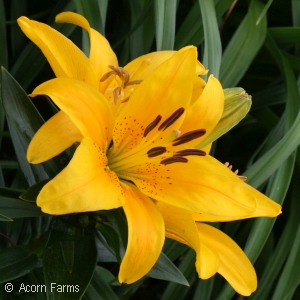
Lilium asiatic 'Tiny Bee', part of the popular Lily Looks™ series, is a cheerful and compact dwarf Asiatic lily prized for its bright, show-stopping blooms. This petite perennial only reaches a height of 12 to 15 inches, making it an ideal choice for the front of a garden border, rock gardens, or container plantings. In early to mid-summer, 'Tiny Bee' produces large, upward-facing, trumpet-shaped flowers on strong, short stems. The blossoms are a vibrant, pure yellow, often featuring subtle black spots near the throat, which contrast beautifully with the plant's dark green, narrow foliage, delivering a bold punch of color to small spaces.
Lilium 'Tiny Bee' thrives in full sun, though it will tolerate very light afternoon shade, as ample sun encourages sturdier stems and abundant blooms. The lily requires nutrient-rich, well-drained soil; the most crucial factor is avoiding "wet feet," as bulbs are prone to rot in soggy conditions. Water regularly to keep the soil evenly moist, allowing the top inch or two of soil to dry out between waterings. After the flowers fade, deadhead the spent blooms to tidy the plant, but allow the foliage to remain until it dies back naturally in the fall. The leaves photosynthesize and generate the energy needed for the bulb to produce the following year's spectacular flowers.
Scroll table horizontally to view all stock & quantities →
PLANT
SIZE
TYPE
GALENA
ADD'L
DIG
SOON
No current sizes listed in database.
Current inventory will be listed above this line. Contact Sales Rep for details. |
Click for key & info
KEY: con = containers - available now Galena = Above ground and available now Additional = Remote location, call rep. Not in Shop. Dig = Still in ground, call rep. Not in Shop (in orange). Soon = Coming soon, call rep. Not in Shop.
(BBnPOT - formerly known as GRSTART - are B&B put into a container - they are available now)
Lily Types:
Asiatic Lily
Asiatic Lilies are native to several areas of Asia. They are easy to care for and the earliest to bloom in the Lily family. Asiatics are fragrance free and come in so many vibrant colors - some even have double blooms! They thrive in all types of soil as long as it is well-drained (add some sand for drainage). These lilies multiply quickly and their bulbs can double every season.
LA Hybrid Lily
L.A. Hybrid Lilies were introduce back in 1992 and are a cross between longiflorum lilies (Easter Lily) and Asiatic hybrids. They get their trumpet shape and longer vase life from the longiflorum, and their warmer flower colors and upward-facing habit from the Asiatic. They have strong, sturdy stems for cutting and are perfect in containers, beds and borders.
Oriental Lily
Oriental Lilies are native to Japan. They are late bloomers - blooming when Asiatic lilies start to fade. They grow considerably taller than Asiatics and are perfect for cut flowers due to their thick, strong stems and heavily fragrance. Yes - they are very fragrant! Their leaves are wider and grows more heart-shaped and their flowers are star-shaped. Their bulbs multiply slower than Asiatic lilies and thrive in well-drained, organic soil.
Planting Tips
ⓘ
To help this plant settle in and thrive, we recommend these standard planting practices: Plant in well-draining soil with a slightly acidic pH. Water regularly, but avoid overwatering. Provide full sun to partial shade. Stake the plant to prevent flopping.

 Protected Series: TINY